Ongoing financial advice costs: what should the fee include?
MoneyHelper uses 0.5% to 1% a year as a broad illustration for ongoing pension or investment advice. That is £500 to £1,000 on £100,000 and £5,000 to £10,000 on £1 million. Your actual comparison should use the cash fee, the written service and all additional investment costs.
One-off and ongoing advice →
What 0.5% to 1% means in pounds
| Amount charged | 0.5% a year | 1% a year |
|---|---|---|
| £100,000 | £500 | £1,000 |
| £250,000 | £1,250 | £2,500 |
| £500,000 | £2,500 | £5,000 |
| £1 million | £5,000 | £10,000 |
Simple annual calculations using an unchanged asset value. MoneyHelper's range is broad context, not a tariff or a quote. Initial advice, platform, fund, product, discretionary-management and transaction charges are excluded.
What can ongoing financial advice cost?
There is no standard UK price. MoneyHelper currently gives 0.5% to 1% of the amount involved as a broad example for ongoing pension or investment advice. Treat that as context, not a tariff, a regulatory cap or an estimate of what a particular firm will charge.
At £100,000, that illustrative range is £500 to £1,000 a year. At £250,000 it is £1,250 to £2,500; at £500,000 it is £2,500 to £5,000; and at £1 million it is £5,000 to £10,000. Those figures exclude any initial advice fee and the costs of the platform, investments or transactions.
The headline rate may not be the rate you pay
A percentage can apply to the whole charged balance or to separate tiers. A firm may also use a minimum annual fee, a cash cap or a fixed retainer. Ask the adviser to calculate the charge on the assets that will actually be included rather than multiplying your total household wealth by a headline rate.
A minimum matters most at lower balances. For example, an invented service priced at 0.5% with a £1,500 minimum would cost £1,500 on £100,000, an effective rate of 1.5%. The same minimum would equal 0.5% on £300,000. A tier or cap can change the relationship again.
Get the current annual fee in pounds and ask what happens if the portfolio rises, falls or is used for withdrawals. FCA guidance says percentage disclosures should make clear that the cash charge may increase as the fund grows.
What can an ongoing service include?
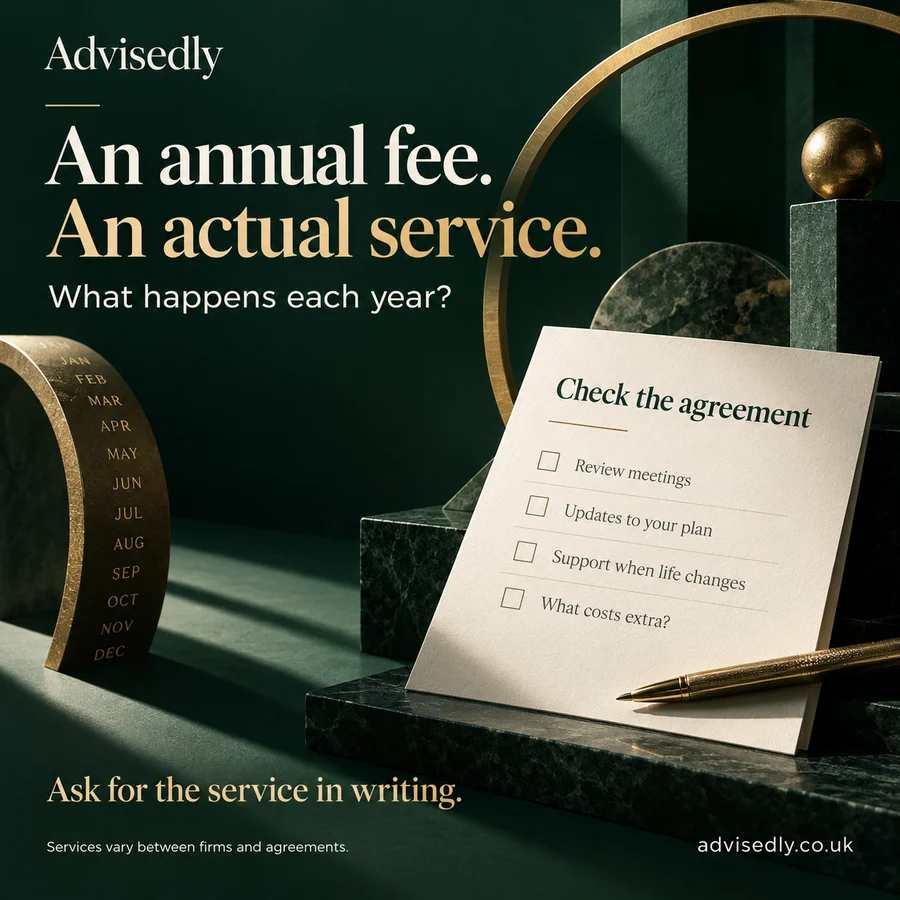
There is no single standard package called ongoing advice. The written agreement should explain the continuing service and its charge. Depending on the firm and your needs, that could include planning reviews, investment oversight, arranging transactions or contact when an agreed change occurs.
Add the costs that sit outside the advice fee
An ongoing adviser charge is not necessarily the total cost of owning the recommended investments. Platform, fund, discretionary management, product and transaction charges can sit beside it. Ask for each layer separately and a combined annual amount in pounds.
Keep the initial and ongoing stages separate. The first year can include planning or implementation charges that do not repeat. A normal later year may cost less, but only if additional planning work is not charged separately. Compare quotes over the same period and using the same asset value.
Compare the agreement with what is delivered
The FCA's 2025 review looked at whether firms had delivered promised suitability reviews. In the sample, firms reported reviews delivered in around 83% of cases; in another 15%, clients declined or did not respond, and in fewer than 2% no attempt was made. The FCA said the sample was not representative of the whole market, so these are review findings rather than an industry score.
For a consumer, the practical lesson is to keep the service description, invitations, review notes and written actions. If you do not understand what happened during the year, ask the firm to map the work back to the agreement. A portfolio valuation on its own does not prove that every promised planning service was delivered.
When might the ongoing fee be worth it?
Ongoing advice may be useful when retirement income, investment risk, business decisions or family circumstances create repeated choices. Continuity can also matter when you want someone to monitor agreed triggers and coordinate changes rather than wait for you to identify the next problem.
It may be less compelling when the plan is stable, you are comfortable monitoring it and the recurring service is mainly a routine meeting. Compare the proposed arrangement with one-off advice, a lighter periodic review or a fixed-fee service. The decision is about responsibility and useful work, not whether one percentage looks normal.
A short checklist for an ongoing-advice quote
The FCA requires firms within the relevant adviser-charging rules to agree and disclose the total adviser charge in cash terms, or provide a cash equivalent where the price is not expressed in cash. The disclosure should identify the service, the charge and how the ongoing arrangement can be cancelled.
A practical way to audit your own annual service
Put the service agreement beside the last twelve months of correspondence. For each promised task, note the evidence of delivery: review invitation, completed meeting, updated assumptions, recommendation or explanation that no change was needed. Mark tasks that depended on information or a response from you separately from work the firm was due to initiate.
Then list decisions that occurred between reviews. Did the service cover the questions you actually needed answered, such as an unexpected withdrawal or change in work? If additional fees applied, were they explained before the work started? A service can meet its written terms and still be the wrong scope for your present circumstances.
Use the next conversation to agree the coming year's work. Ask what will be monitored, which changes you must report and what a useful completed review will contain. Request a current cash illustration of the ongoing charge so the service and its price can be considered together.
This exercise is a record of the relationship, not a score for investment performance. It helps distinguish a quiet year in which appropriate work was completed from a year in which an agreed service was missing. Where there is a gap, ask for an explanation and a specific remedy, retaining the correspondence if a formal complaint becomes necessary.
Sources and further reading
MoneyHelper - Financial adviser fees ↗
FCA - Adviser charging rules ↗
FCA Handbook - COBS 6.1A adviser charging ↗