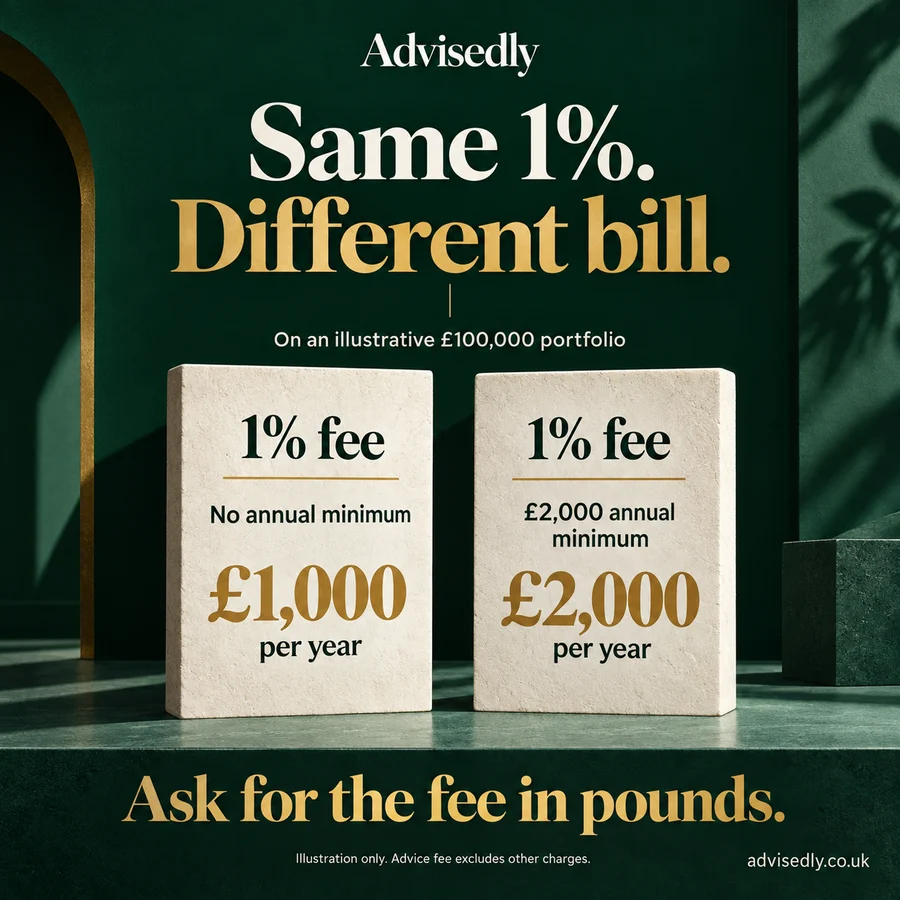
How much does a financial adviser cost in the UK?
The cost depends on the work you need and how the adviser charges. Ask for a written price for the initial advice, any work to put it into action, and any ongoing service. Compare the total in pounds, including minimum fees and other charges.
Compare 50 firms' published disclosures →
Three ways a quote can reach £2,000
| Charging method | Illustrative calculation | What to establish |
|---|---|---|
| Fixed | £2,000 for the agreed work | Which meetings, report and follow-up are included? |
| Hourly | 8 hours at £250 = £2,000 | Is there an estimate or spending limit before extra work begins? |
| Percentage | 1% of £200,000 = £2,000 | Which assets count, and does a minimum or cap apply? |
These are invented examples of the maths, not typical prices or firm quotes. Equal fees do not mean equal services. Implementation, ongoing advice, investment charges and VAT where applicable may be additional.
The short answer
There is no standard UK price for financial advice. MoneyHelper currently gives broad examples of £100 to £350 an hour, 1% to 3% of the amount involved for initial pension or investment advice, and 0.5% to 1% a year for ongoing advice.
Those are market illustrations, not a tariff and not an estimate of what a named adviser will charge.
The main charging models
Worked example: the first year and a later year
Suppose an invented quote charges £2,000 for the plan, £1,000 to put it into action and 0.75% a year for ongoing advice on £250,000. The annual adviser fee is £1,875. If the full annual charge applies from the start, the first-year adviser bill is £4,875; a later full year is £1,875 if no extra work is commissioned.
This keeps the balance and rate constant and excludes platform, fund, product and transaction costs, VAT and the effect of taking fees from investments. Confirm when charging starts and whether implementation is included in, or offset against, the planning price. Otherwise you can accidentally count the same work twice.
What affects the price?
Complexity, the amount of work, how advice is delivered, who carries out the work and how investments are managed can all affect cost. Location may also influence a firm's overheads.
Ask what you will pay in year one and in a normal ongoing year, then compare what service is included.
The adviser fee may not be the whole cost
The adviser’s fee pays for the agreed advice service. The total cost can also include charges for putting recommendations into action, holding investments on a platform, funds or products, and transactions. Ask which charges are included in each quote so you can compare the same work without counting anything twice.
What should you know before you commit?
You must be told how much the advice will cost before you sign up. If there is an ongoing charge, ask what ongoing work you receive for it and whether the charging structure is fixed, percentage-based, tiered or capped.
Split the quote into jobs
Ask for separate prices for understanding your finances and making a plan, giving a recommendation, putting it into action and reviewing it later. A firm may charge a fixed amount, a percentage of your investments or a mix. Check what work each charge covers.
Request an example in pounds at your expected asset level. If the fee is tiered, ask for the blended amount and the marginal rate on each band. Clarify whether the fee is taken from investments, paid directly or subject to VAT.
- Year oneInclude the initial fee, implementation work and the first recurring charge.
- A normal later yearShow the ongoing fee and what work is included if nothing unusual happens.
Do not hide the other layers
Platform, fund, product and transaction charges can sit beneath an adviser fee. Ask for them separately and ask whether the recommendation is restricted to a particular platform or provider. A lower adviser percentage does not automatically mean a lower total cost.
Compare like with like: the same level of planning, the same investment responsibility and the same access to the adviser.
- Useful question‘What is the total expected cost in pounds for the first year and for a typical following year?’
- Useful documentA service and fee schedule that you can keep, rather than a verbal estimate.
Use a quote as a decision tool
If the price is outside your budget, ask whether the scope can be narrowed safely. Do not ask a firm to remove work that is essential to a suitable recommendation simply to reach a target number.
Turn a quote into a total-cost worksheet
Suppose a firm quotes a fixed initial fee and an ongoing percentage. Write both on separate lines, then add any minimum, cap, implementation charge and VAT treatment. Do not let a single ‘from’ price become the number you use for comparison.
Now add the underlying arrangement. Ask for the platform fee, investment or fund charge, product charge and transaction costs. Some costs vary with the chosen solution, so record the assumptions and ask what would make the total rise or fall.
Create two snapshots: the first twelve months and a normal later year. Include the work you are actually buying in each. If the adviser will review a retirement income plan quarterly, that is a different service from a yearly meeting about a static portfolio.
Use the same asset value and same scope when asking a second firm for a quote. Otherwise a cheaper answer may simply exclude the difficult work. Ask both firms to explain what they would do if your circumstances change between reviews.
Finally, consider how the fee is paid. A charge deducted from investments still reduces what remains invested; a direct invoice affects household cash flow. The payment route is not the same as the cost, so record both clearly.
- Initial feeWhat analysis, recommendation and implementation does the first charge cover, and when is it due?
- Ongoing feeWhat recurring work happens in a normal year and what would trigger an additional charge?
- MinimumDoes a minimum override the percentage at your current assets or income?
- Other layersWhich platform, product, investment and transaction charges are outside the adviser fee?
- ExitCan you stop the service, and are any future charges or product consequences explained in writing?
Your total-cost record
Write the service in stages: fact-find, recommendation, implementation and review. A quote is easier to compare when each stage says what you receive and what the adviser is not undertaking.
Calculate the initial cost and a normal later year at the same asset value for every firm. Add minimums, tiering, VAT treatment, platform charges, investment charges and any product or transaction costs.
Ask what happens when the scope changes. A retirement decision, large withdrawal or extra meeting may be included, separately charged or referred elsewhere. Record the answer before treating two quotes as comparable.
Keep the schedule and set a price review date. If the cost rises without a corresponding change in work, ask for an explanation and consider changing the service or ending it under the stated terms.
- What the service includesWhat exact work is included in each stage?
- MathsWhat is the total cash cost in year one and later years?
- LayersWhich platform and investment costs sit underneath?
- ChangeWhat request creates an extra fee?
- ExitHow do you stop and what costs remain?
Use published fees as a starting point for a quote
Our fee research records publicly available information from a selected sample of firms. It is useful for identifying charging models and questions to ask, but the firms do not all quote for the same work. A price range assembled from different services is not automatically a market benchmark for your case.
Send shortlisted firms the same short brief and request a first-year adviser total, a normal ongoing-year total and a list of costs charged by other providers. State the relevant asset value, the decision and whether you want implementation or only a plan. Ask the firm to identify any assumptions that could change its quotation.
Where a schedule contains tiers, minimums or separate charges, ask the firm to show the calculation. A simple percentage calculator cannot resolve an ambiguous contractual rule. Keep the dated source or quote so a later change can be understood rather than mistaken for a calculation error.
Finally, compare the output. A document-only plan, an implemented recommendation and a continuing advice relationship are different services. The useful result of fee research is a better purchasing decision, not a conclusion that the smallest number must be the best offer.
Your decision checklist
- Get initial and ongoing charges separately
- Ask for a worked example at your asset level
- List platform, fund and product charges
- Confirm VAT, minimums, caps and cancellation terms
When you may need personal advice
Fee comparisons cannot predict investment returns or prove that a cheaper service is suitable. They show what you are paying for and make trade-offs visible.
Sources and further reading
MoneyHelper - Financial adviser fees ↗
Advisedly: published financial advice fees research and methodology ↗