Is a 1% financial adviser fee expensive?
A 1% annual adviser fee is £1,000 for each £100,000 covered by the charge: £2,500 on £250,000, £5,000 on £500,000 and £10,000 on £1 million. Whether it is expensive depends on the work included, fee rules and every additional investment cost.
Put two written quotes side by side →
1% in annual, monthly-equivalent and ten-year pounds
| Amount charged | One year | Monthly equivalent | Simple ten years |
|---|---|---|---|
| £100,000 | £1,000 | £83.33 | £10,000 |
| £250,000 | £2,500 | £208.33 | £25,000 |
| £500,000 | £5,000 | £416.67 | £50,000 |
| £1 million | £10,000 | £833.33 | £100,000 |
The monthly column divides the annual fee by 12; it does not say the fee is billed monthly. The ten-year illustration assumes the same asset value and 1% rate every year, with no growth, withdrawals, investment effect or other charges.
Start with the 1% calculation
Multiply the amount covered by the charge by 0.01. If one rate applies to the whole balance for a full year, 1% is £1,000 on £100,000, £2,500 on £250,000, £5,000 on £500,000 and £10,000 on £1 million.
The table above also gives a monthly equivalent and a simple ten-year figure. The monthly figure is only the annual amount divided by 12, not a claim about when a firm collects the fee. The decade figure keeps the balance and rate unchanged and excludes the investment effect of fee deductions.
Separate the first year from a normal ongoing year
MoneyHelper currently uses 1% to 3% of the amount involved as a broad initial pension or investment advice illustration, and 0.5% to 1% a year for ongoing advice. Initial advice and ongoing service are different stages. They are not automatically both charged, may use different asset bases and the ongoing amount may be reduced if it starts partway through a year.
If, purely for illustration, MoneyHelper's full initial range and a full year at 1% all applied to the same amount, the first-year adviser charges would look like this:
Real firms may use fixed fees, cash caps, lower rates at higher asset levels or a different basis for initial work. Ask for your personalised first-year total and normal later-year total in pounds.
A lower first-year bill can mean higher ongoing costs
Imagine two quotes for comparable work on £250,000. Quote A charges £1,000 initially and 1% a year for advice: £2,500 ongoing, or £3,500 in the first full year. Quote B charges £2,000 initially and a fixed £2,000 a year: £4,000 in the first full year, then £2,000 annually.
A has the lower first-year advice bill; B has the lower recurring advice charge at that unchanged balance. This is an invented example, with a full year of ongoing advice and no investment growth or withdrawals. It excludes platform, fund and other charges; assume any applicable VAT is already included. It does not establish which service offers better value.
Use the two-quote comparison tool to enter your own written figures, add other charges and record the services offered. Leave an unknown cost blank until the firm confirms it.
1% sits at the top of MoneyHelper's broad ongoing illustration
MoneyHelper currently gives 0.5% to 1% for ongoing pension and investment advice. That makes 1% the top of its broad illustration, but the range is not an FCA tariff, a regulatory cap or proof that a fee is fair or excessive.
A complex service can include recurring retirement planning, cash-flow reviews, investment oversight, family decisions and access between meetings. Another service at the same rate may be narrower. The label and percentage do not show the responsibility transferred to the adviser.
Compare at least one alternative structure. A fixed-fee or periodic service might suit a stable, defined need. An ongoing relationship may be more useful where withdrawals, business interests, investment risk or family circumstances create repeated decisions.
Add the other costs before judging 1%
The adviser charge may be only one layer. Platform, fund, product, discretionary-management and transaction charges can sit beside it. Ask for each amount separately and a combined annual total, using the same balance and period.
For an invented illustration, add a 1% adviser charge, 0.25% platform charge and 0.20% fund cost. If all three percentages apply to the same unchanged balance for a full year, the combined rate is 1.45%.
Those rates are invented to demonstrate addition, not typical prices. A real disclosure may use different charging bases, bundle one cost inside another or include costs that cannot be added by simply summing headline percentages.
Minimums, tiers and caps can change the answer
A minimum fee can make the effective rate higher at a smaller balance. A cap can stop the cash charge rising after a point. Tiered pricing can apply lower rates to assets above set thresholds, so the effective percentage falls as the balance grows.
Imagine 1% on the first £250,000 and 0.5% on the balance above that. At £500,000, the charge would be £2,500 plus £1,250, or £3,750 in total. That is an effective rate of 0.75%, not 1% of the whole £500,000. At £1 million, the same invented marginal tiers produce £6,250, an effective rate of 0.625%.
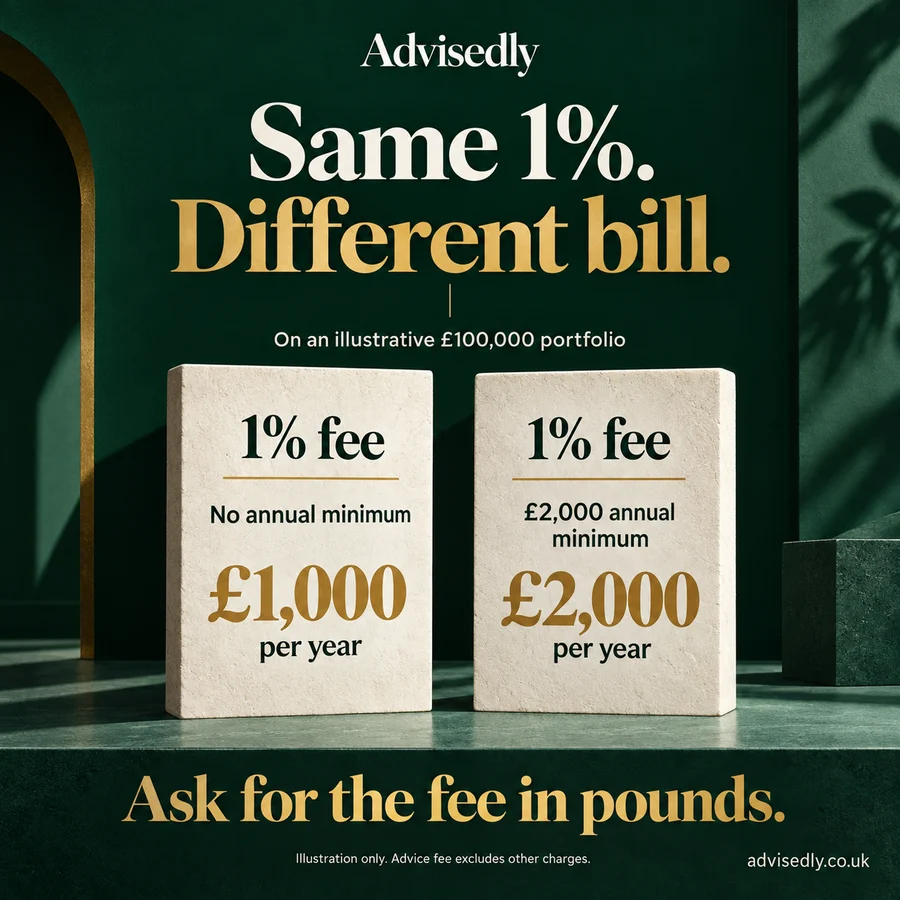
A minimum can work in the other direction. An invented 1% rate with a £2,000 annual minimum costs £2,000 on £100,000: an effective 2%. On £250,000 it costs £2,500, because the percentage exceeds the minimum. Check the actual minimum in the firm’s terms before using a percentage calculator. Our minimum-fee research keeps these conditions alongside the original sources.
Confirm whether each rate applies only within its band or whether crossing a threshold changes the rate on the whole balance. Request the calculation line by line.
Compare the service, not just the number
The FCA says percentage charging should be illustrated in cash terms. For an ongoing charge, the firm should explain the service, its cost and how to cancel. FCA guidance also says the disclosure should make clear that a percentage charge may rise as the fund grows.
In its 2025 review, the FCA found that ongoing services in its sample varied and generally included suitability reviews. It told firms to ensure consumers receive the service they pay for. The review sample was not representative of the entire market, so use it as a prompt to check your own agreement rather than as an industry score.
Questions to ask about a 1% quote
A useful final question is: “At today's balance, what would I pay in year one, what would I pay in a normal later year, and what recurring work is each amount buying?”
Translate the rate
At £100,000, 1% is £1,000 a year before other charges. At £500,000 it is £5,000. The calculation is simple. The question is whether the help you receive is worth that yearly cost.
Check whether the percentage applies to all assets, only advised assets, or bands of assets. A minimum fee can make the effective rate higher for smaller portfolios.
- AskIs the rate charged on cash, pensions and investments equally, and does it change at set bands?
- CompareWhat would the same planning cost as a fixed-fee or one-off engagement?
Define what you receive
An ongoing fee should describe recurring work: planning updates, review meetings, investment oversight, withdrawal decisions or access between reviews. ‘Annual review’ is too vague on its own. Ask what happens in a quiet year and in a year when your circumstances change.
If the firm mainly manages investments while you do the planning, compare it with a service that includes broader financial planning. Scope is often more important than a small difference in headline rate.
- Value is visibleYou know who is responsible for which decisions and when they will be revisited.
- Value is unclearThe charge continues but the service is described only as ‘peace of mind’.
Reassess, do not assume
Ask for an annual fee review and understand how to stop or change the service. A fee that suited an accumulation phase may not suit a simple post-retirement plan.
Stress-test a 1% proposal
Take the proposed balance and multiply it by 0.01 to establish the annual adviser cost. Then repeat the calculation for a lower balance and a higher balance. This shows whether the charge changes materially as markets or withdrawals alter the assets under advice.
Next, describe the service without using the word ‘review’. Does the adviser revisit spending, risk, pensions, beneficiaries or tax coordination? Does the firm act between meetings when agreed triggers occur? If the answer is simply that someone looks at the portfolio once a year, compare the scope with a lighter service.
Ask for the investment and platform layers too. A 1% adviser charge may be only one part of the cost, and the adviser may not control every layer. You need to know whether the recommendation is cost-efficient as a whole, not whether one number sounds familiar.
Imagine two years: a quiet year in which nothing changes and a year in which you need to fund a large expense. Ask what the adviser would do in each and what would be charged. This makes ‘ongoing value’ concrete rather than rhetorical.
Use the answer to set a review date. If your needs become simpler, you can ask whether a one-off or periodic service is enough. If they become more complex, you can check whether the existing scope is still adequate.
- Cash impactWhat is 1% in pounds at today’s balance, after any tiering or minimum?
- Asset baseAre all assets charged, including cash or accounts the adviser does not manage?
- ServiceWhat work is guaranteed each year, and what is discretionary?
- AlternativesCould a fixed project or periodic review solve the specific problem?
- ReviewWhen will you reassess whether the ongoing fee still matches the work?
Your 1% value test
Convert the proposed 1% to pounds at your current balance and at a plausible lower balance after withdrawals. Check whether the charge applies to cash, pensions or only assets the adviser actively manages.
Describe the recurring work without using ‘peace of mind’: planning, income reviews, investment oversight, access and action between meetings. If the list is short, compare a periodic or fixed-fee service.
Ask for the quiet-year and change-year service. You should know what happens when nothing changes and when you need a large withdrawal, a retirement decision or a family-planning update.
Set a reassessment date and keep the service promise. The right to change or stop matters because a fee that fits an accumulation phase may not fit a simpler later plan.
- PoundsWhat exactly does 1% cost at your balance?
- BaseWhich assets are included in the calculation?
- WorkWhat recurring decisions will the adviser actually handle?
- AlternativesWhat lighter service could solve the same problem?
- ReassessWhen will you review the value against the fee?
Separate the service review from the market review
When reviewing a 1% charge, use two records: the work promised and delivered, and the investment arrangement's results and risks. Keeping them separate helps avoid concluding that a rising market proves the advice was valuable or that a falling market proves it was poor.
Ask the firm to explain the decisions its service supported, including decisions not to change an arrangement. Then compare the total charge with an equivalent scope elsewhere. A cheaper proposal is informative only once its exclusions, initial costs and ongoing responsibilities are clear.
For an unchanged £600,000, 1% means £6,000 a year before other charges. This simple illustration makes the service question tangible without claiming that £6,000 is either justified or excessive in every case. If only part of the assets needs ongoing work, ask whether the quoted scope and charging base reflect that.
If you agree a different arrangement, record when it starts and how it affects the existing plan. A fee review should result in clear responsibilities, not merely a lower number with uncertainty about who will handle the next important decision.
Your decision checklist
- Calculate the annual pounds at your balance
- Check tiers, minimums and what assets are included
- List the recurring work and access
- Compare a one-off alternative before agreeing
When you may need personal advice
No rate alone shows whether advice is suitable or valuable. This is a comparison framework, not a recommendation about paying or cancelling a fee.
Sources and further reading
MoneyHelper: Guide to financial adviser fees ↗
FCA Handbook: COBS 6.1A adviser charging and remuneration ↗
FCA: Ongoing financial advice services review ↗
Advisedly: published financial advice fees research and methodology ↗