What happens at a first financial adviser meeting?
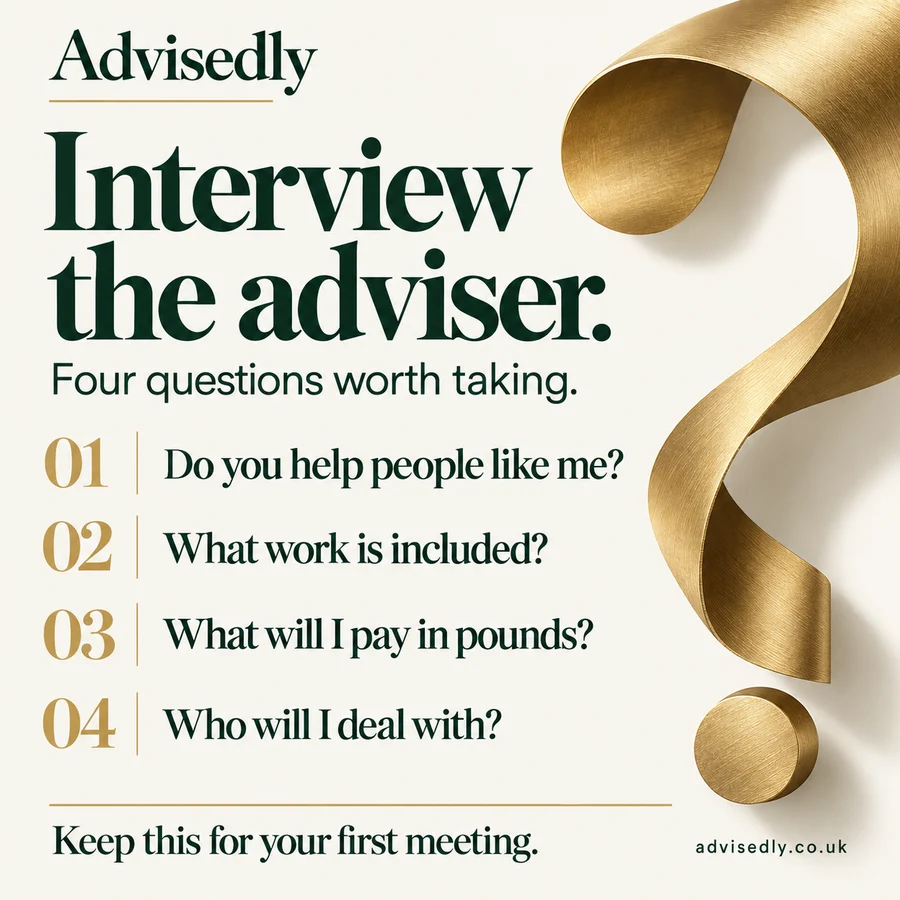
A first meeting usually explores your goals and whether the firm can help. It should also explain the service, charges and next steps. Confirm whether the meeting is free and what, if anything, you are agreeing to before paid work starts.
Choose an adviser for your needs →
A simple first-meeting plan
| When | Your task | Useful outcome |
|---|---|---|
| Before | Write the main decision and gather relevant summaries | A clear explanation of why you want help |
| During | Ask about experience, scope and the full price | Enough detail to compare the service |
| After | Read the proposal and clarify missing points | A decision about whether to proceed |
A free introductory conversation does not necessarily include a personal recommendation or written financial plan. Ask what this particular meeting covers.
What is the first meeting for?
A first conversation normally helps the adviser understand why you are looking for help and gives you a chance to understand the firm, the adviser and the service. It may be relatively high level before a more detailed fact-find begins.
Use the meeting to test fit as well as competence. Ask who the adviser normally works with, whether your problem sits inside their usual specialism and what happens next if you decide to proceed.
What will the adviser ask?
When should fees be discussed?
Before you commit to paid advice, the charging basis and expected cost should be clear. Ask for the amount in pounds as well as any percentage and separate adviser fees from platform, fund or product charges.
Ask what you would pay in year one and what a normal ongoing year would cost.
Do you have to say yes in the meeting?
No. A useful first meeting should leave you with enough information to decide whether you want to continue. Comparing more than one adviser can be sensible when service, specialism or price differs materially.
Prepare a decision note
Bring a short description of the decision, the deadline, your preferred level of support and any constraints. You can bring relevant statements, but do not send passwords or unnecessary identity documents through ordinary email.
Tell the adviser what you do not yet know. A good meeting makes uncertainty explicit and explains what information would be needed before a recommendation.
- Useful to bringPension or investment statements, broad income and spending information, debts and important commitments.
- Useful to askWho normally handles a situation like mine, and what would you do next?
Expect questions, not a finished answer
The adviser may ask about goals, family, time horizon, experience, attitude to risk, capacity for loss and preferences. That fact-find is part of suitability; it should not be rushed to support a pre-selected product.
Ask what is being gathered now, what will be confirmed later and when you would receive a written recommendation.
- Listen forClear explanations of assumptions, uncertainty and the difference between guidance and a personal recommendation.
- Pause forAny request to sign, transfer money or reveal security information before scope and fees are clear.
Leave with a decision pack
Before agreeing to proceed, ask for the service description, charging basis, expected timescale, complaints route and next steps. Compare it with at least one alternative if you are unsure.
The meeting is successful if you know whether there is a fit, even if the answer is no. A professional adviser should respect that decision.
Leave the meeting with evidence, not pressure
Before the meeting, choose three outcomes: understanding whether the adviser can help, knowing the likely scope and knowing the cost of the next step. You do not need perfect paperwork, but you do need a clear question and a secure way to share relevant information.
During the fact-find, notice whether the adviser listens for goals and constraints or moves quickly to a preferred product. Questions about income, spending, pensions, debts, family and risk should be connected to the decision, not collected as decoration.
Ask what is free and what becomes chargeable. Request the service description, fee basis, initial and ongoing examples, expected timescale and complaints route. If the adviser cannot explain the next document or decision, you are not ready to commit.
At the end, repeat the scope in your own words and ask the adviser to correct anything inaccurate. Take away the material and compare if you need to. A first meeting is a suitability conversation, not an auction and not a promise to proceed.
If you do proceed, record what you expect to happen next and when. If you do not, keep the notes: they can improve the next meeting and help you recognise whether another firm is asking better questions.
- PreparationWhat decision, deadline and constraints can you explain in two minutes?
- Fact-findAre questions relevant to suitability, and is uncertainty acknowledged?
- CostWhat is free, when does payment begin and what is the expected cash amount?
- DocumentsWhat will you receive before any recommendation or implementation?
- ChoiceCan you take time, compare and decline without pressure?
Your first-meeting record
Bring a short decision note, deadline, preferred level of help and relevant information. Do not send passwords or unnecessary identity documents simply because a meeting has been arranged.
Record whether the adviser asked questions connected to suitability or moved directly to a preferred product. Note what information remains outstanding and when a written recommendation would be provided.
Write down what is free, when charges begin, the initial and ongoing examples, expected timescale, complaints route and next step. Ask for the service description before agreeing to implementation.
After the meeting, explain the proposal in your own words and compare if necessary. A pressured request to sign, transfer money or disclose security information is evidence about fit and should be treated seriously.
- PurposeWhat decision is the meeting meant to clarify?
- Fact-findWhich relevant facts were gathered or left open?
- CostWhen does payment start and what is the cash amount?
- DocumentsWhat will arrive before a recommendation?
- ChoiceCan you pause and decline without pressure?
Use the meeting to test the process
A useful first meeting should clarify the problem, relevant background and whether the firm is likely to be suitable. It may cover goals, household finances, pensions, investments, debts, dependants, risk and timescale, but you should not be pressed to disclose information that is unnecessary before the firm has explained who it is and how it works.
Ask when regulated advice begins and what is free. An introductory conversation, paid fact-find, financial plan, suitability report and implementation can be separate stages. Record the deliverable, price and cancellation point for each stage so that a friendly meeting does not create an assumed commitment.
Use the conversation to check fit. Ask about clients with a similar need, relevant restrictions or permissions, minimums, communication and who would actually do the work. If another firm, platform or investment manager is involved, identify its role and the additional charge.
Afterwards, write the proposal in your own words. If you cannot explain what the adviser will do, what it costs and what remains your responsibility, ask for clarification before sending sensitive documents or agreeing to proceed.
You do not need to choose at the meeting. Ask for the firm’s disclosure and fee documents, check its identity independently and compare the proposed service in your own time. Space to make that decision is itself useful evidence about the relationship.
Turn the meeting into a decision record
Before the conversation, write down the decision you want help making and the main uncertainty preventing you from making it. Bring approximate figures with their dates, and identify any deadline. You can use the meeting to discover what further information matters; you do not need to pretend your records are complete.
Afterwards, create a brief record with five answers: what work is proposed, who will do it, what it costs, what you will receive and what starts the paid engagement. If one answer is missing, ask before proceeding. This is more useful than judging the meeting solely by how reassuring it felt.
An illustrative retirement enquiry might end with a proposal for a pension and income review, rather than an immediate product recommendation. Ask whether the fee covers provider research, a written plan, discussing alternatives and implementation. Also ask what you pay if the advice is to keep the existing arrangements. Those details establish the value of the assessment itself.
Tell the firm if you need a partner present, a longer explanation or documents in a different format. A first meeting should help you understand the service well enough to choose it. If you decide not to proceed, keep any useful factual information and avoid signing authorities merely to be polite.
Your decision checklist
- Write the decision and questions down
- Bring relevant information securely
- Ask about scope, fees and timescale
- Take time before signing or transferring money
When you may need personal advice
A first meeting cannot establish suitability by itself. A regulated personal recommendation requires appropriate information and formal documentation.
Sources and further reading
MoneyHelper - Choosing a financial adviser ↗