How to check if a financial adviser is FCA regulated
Check the real firm, the reference, the contact details and the relationship between an adviser and any principal firm before you appoint anyone.
Check an adviser →
Why check the FCA Register?
The Financial Services Register is the FCA's official public record of firms and individuals carrying out regulated financial-services activity. Checking it helps you confirm that the person or firm you are dealing with is the real regulated business.
What should you check?
What does appointed representative mean?
An appointed representative carries out certain regulated activities on behalf of a principal firm. The principal is responsible for the activities it has permitted the appointed representative to carry out.
If you are unsure what an appointed representative can do, the FCA advises checking with the principal.
How the Advisedly checker helps
Advisedly's checker helps you search for a firm or individual and understand the result. It links to the official FCA record so you can check the details yourself.
Search from an independent starting point
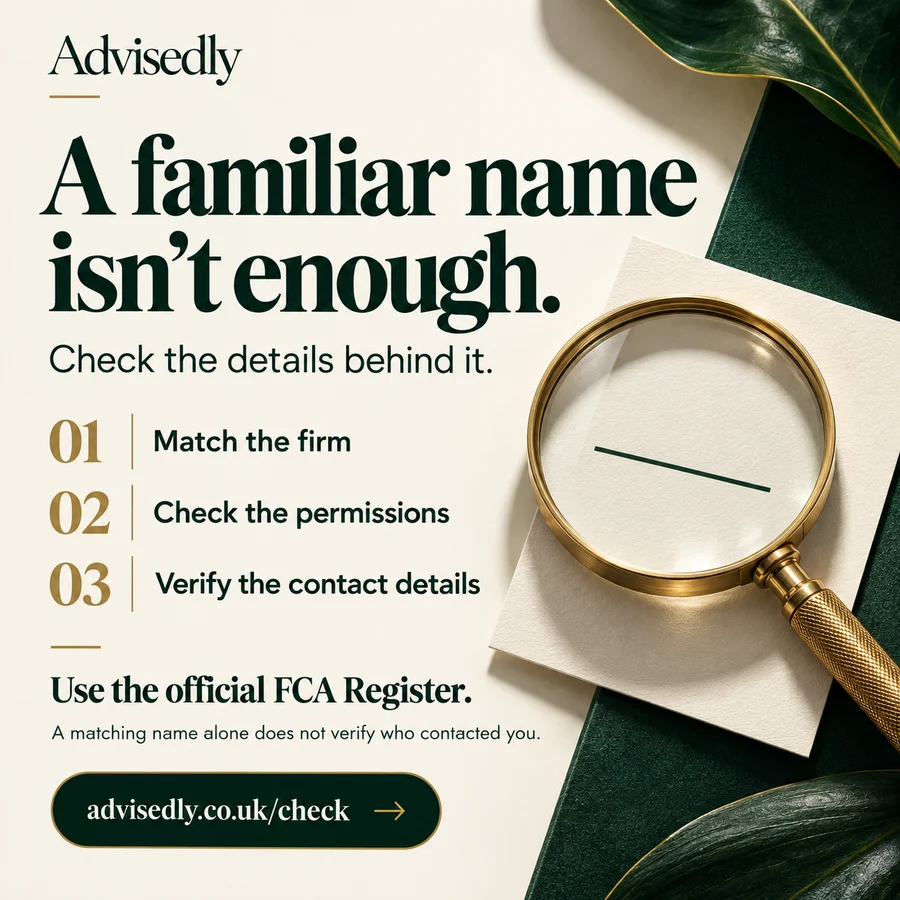
Type the firm name or reference into the FCA Register yourself rather than relying on a link supplied in an unsolicited message. Check the status, legal name, trading names and contact details. An authorised firm may have permissions that do not cover every service it advertises.
If the individual is an appointed representative, check the principal firm and understand which business the principal accepts responsibility for. Ask the adviser to explain any difference between the name on the register and the name on their website.
- MatchThe telephone number, email domain and address you use should agree with the register or be independently verified.
- PauseA warning, unauthorised status or unexplained mismatch is a reason to stop and investigate.
Regulated does not mean suitable
Checking the FCA record is a first step. It is not a recommendation to use the adviser. It does not tell you whether the adviser is independent, whether the service fits your needs or whether a recommendation will be suitable for you.
Keep the register check separate from a service comparison. Verify first; then ask about specialism, charges, scope and complaints handling.
- RecordSave the firm name, reference, date checked and contact details you verified.
- ProtectDo not send passwords, one-time codes or money to ‘secure’ a meeting.
If something does not add up
Stop contact, do not transfer money and use the FCA’s consumer guidance or complaints route. If you are already a client, keep copies of messages, agreements and payment records.
Keep a dated verification record
Start the check before a meeting if possible. Search the FCA Register using the firm’s legal name or reference, then compare the record with the website, email domain, telephone number and payment details. Save the result or note the date because status and details can change.
Read the permissions in context. Authorisation does not mean a firm can provide every kind of pension, investment or protection service. Ask the adviser which permission covers the work you are discussing and whether another firm or principal is involved.
If the name is a trading style, identify the legal entity behind it. If the adviser is an appointed representative, understand the principal relationship and which business is covered. A mismatch is not something you should resolve by trusting the explanation alone.
After the check, make a separate suitability assessment. Ask about independence, specialist experience, client minimums, fees and complaints. A clean register result is an entry condition, not a recommendation or guarantee.
If anything changes, such as new bank details, a new email address, pressure to transfer money or a different legal name, repeat the check. Use independently sourced FCA guidance and keep evidence of what was said.
- IdentityDo the legal firm, adviser, website and payment destination match?
- StatusIs the firm authorised, an appointed representative or showing a warning?
- PermissionDoes the permission cover the actual advice service being discussed?
- DateHave you recorded when you checked and what details were visible?
- EscalationWhat will you do if the record, contact details or story do not agree?
Your verification record
Search the FCA Register independently and note the legal name, reference, status, permissions, trading names and contact details shown on the date checked. Keep a copy or a dated note rather than relying on memory.
Match those details to the website, email domain, telephone number and payment destination. If the person is an appointed representative, record the principal firm and ask which activity it accepts responsibility for.
Treat authorisation as a threshold, not a recommendation. Complete a separate fit check covering specialism, independence or restriction, client minimums, fees and complaints handling.
Repeat the check if details change or a transfer is requested. If the record and the conversation do not match, stop sharing information and use current FCA consumer guidance to decide what to do next.
- IdentityDo the firm, adviser and payment details match?
- PermissionDoes the permission cover this exact service?
- DateWhen was the register result checked?
- FitWhat separate evidence supports suitability?
- MismatchWhat is your safe escalation route?
Read the register result in the right order
Begin with identity. A brand name may differ from the legal firm shown on the register, so connect the trading style, legal entity and firm reference number before relying on the result. If a person contacts you, check that the individual’s record and current firm relationship support the account they have given you. Do not treat a matching name alone as enough evidence.
Next consider status and permissions. A firm can appear on the register without every proposed activity falling within its permissions. Ask which regulated activity covers the specific pension, investment or protection work under discussion. Where an appointed representative is involved, identify the principal firm and understand which activities the principal accepts responsibility for.
Then compare contact details. Clone scams can copy the name and reference number of a genuine business while changing the telephone number, email domain or payment instructions. Start from a contact route you found independently. If the register carries a warning or the details do not agree, pause the conversation rather than allowing the person who approached you to explain the mismatch away.
Finally, remember what the check cannot establish. A current authorisation or approval status does not prove that the adviser is suitable for your need, competitively priced or likely to provide a good service. Treat regulation as one threshold, then separately compare specialism, restrictions, typical clients, fees, service responsibilities and complaints information.
Keep a dated note of what you checked, particularly before transferring money or signing an agreement. If bank details, personnel or the legal entity later change, repeat the verification from an independent starting point. This creates a simple record of the identity and permissions you relied on at the time.
If the checker cannot return a record, use the official FCA Register directly. An unavailable search is not evidence that a firm is authorised or unauthorised, and it should never be converted into a reassuring result.
Keep a dated identity record before sharing sensitive information
Record the legal firm, trading name, individual adviser, relevant status and verified contact route. If an appointed representative is involved, include the principal. This creates a reference you can return to when a later email asks you to send documents or change payment instructions.
Navigate to the official register independently rather than relying on a link supplied in an unsolicited message. Match the relationship and activity, not just a reference number. If the details are incomplete or do not match, contact the firm or principal using an independently verified route.
An illustrative impersonation could use a genuine firm's name and number but a different email address and bank account. Finding the genuine firm on the register would not authenticate that message. The contact check connects the register entry to the actual person communicating with you.
Do not treat authorisation as a guarantee that every product, investment or loss is protected. Permissions, the activity and eligibility rules matter. Ask the firm to explain the protection relevant to the proposed service and retain that explanation with the recommendation.
Your decision checklist
- Find the firm on the FCA Register yourself
- Match legal name, status, permissions and contact details
- Check appointed-representative arrangements
- Treat register status as a starting point, not a recommendation
When you may need personal advice
Register information can change. Check it close to the time you engage and use the FCA’s current record and guidance.
Sources and further reading
FCA - Financial Services Register ↗