How to find and choose a financial adviser in the UK
Start with the decision you need help with. Check the firm and its relevant permissions, then compare experience, service, minimum requirements and the full cost. Use the first conversation to decide whether to request a written proposal.
Check the adviser and responsible firm →
What to establish before you agree
| Check | Evidence to look for | A useful question |
|---|---|---|
| Identity and permissions | The responsible firm, genuine contact details and relevant regulated activities | If you are an appointed representative, which principal is responsible for this work? |
| Advice scope | Independent or restricted status for the service being quoted | What products, providers or services are outside your scope? |
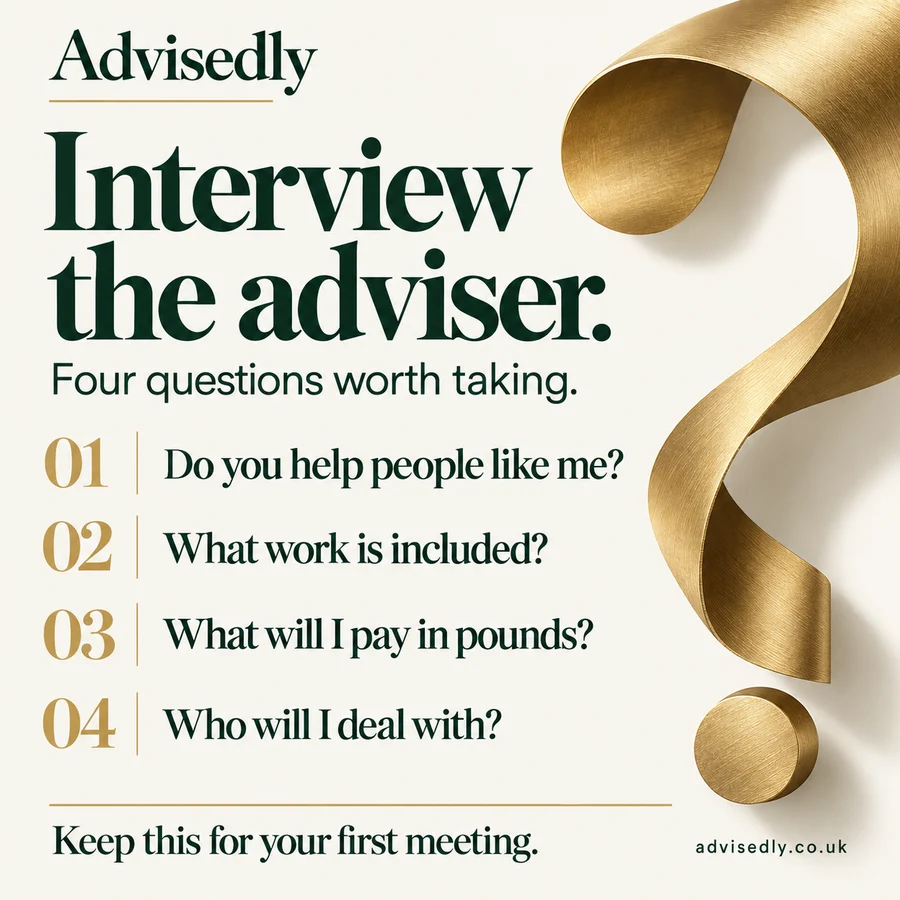
| Relevant experience | Examples of the type of work, minimum requirements and exclusions | Do you regularly help people with this decision and asset level? |
| Price and deliverables | A written proposal based on the same brief you give each firm | What will I receive, what is extra, and what is the total first-year cost? |
| Working relationship | Named contact, meetings, follow-up and cancellation terms | Who handles questions after the plan and what further work costs extra? |
A register entry, professional title or positive review is one part of the check. It does not establish that a particular recommendation will be suitable for you.
Find an adviser for the help you need
A financial adviser can be perfectly legitimate and still be a poor fit for your situation. Before looking at individual names, write down the decision you are trying to make: retirement income, pensions, investing a lump sum, planning around a business, inheritance, protection or something else.
Specialist experience matters most when the situation is less standard. Someone preparing to sell a business, for example, may value an adviser who regularly works with founders more than someone who happens to be two streets closer.
To find potential advisers, you can use professional directories, ask for recommendations or request an introduction. MoneyHelper explains the main routes. With Advisedly, you can start with the type of advice you need and send an enquiry for human review and a possible introduction.
Check the adviser and firm are properly authorised
MoneyHelper recommends checking the FCA Financial Services Register to confirm the adviser or firm is authorised and that the contact details are genuine. If someone appears as an appointed representative, they provide regulated activity under the responsibility of a principal firm.
Matching and reviews come later. First establish that you are dealing with the real regulated firm or adviser.
Check who they help and how they work
Ask who the adviser normally works with, what their stated minimum asset level is, whether they offer the type of ongoing relationship you want, and whether they can meet face-to-face if that matters to you.
A strong shortlist usually has more than one name. MoneyHelper suggests comparing several advisers so you can compare costs and service rather than treating the first conversation as the only option.
Give each firm the same short brief: the decision, your approximate pensions and investments, the timing and whether you want a one-off plan or continuing help. Ask each to confirm the proposed work and exclusions. Comparing one firm's planning-only quote with another firm's implementation and annual service will not give you a useful price comparison.
Compare fees in pounds, not just percentages
Advisers can charge fixed fees, hourly rates, percentages or combinations of these. MoneyHelper currently gives broad examples of 1–3% for initial pension/investment advice and 0.5–1% for ongoing advice, while stressing that actual costs vary by adviser and complexity.
Those ranges give useful context, but they do not tell you what a particular adviser charges. Ask for the actual initial and ongoing amount, how it is calculated, and what ongoing service is included.
Our research into 50 firms' published fees shows why scope matters: planning and implementation can be separate, included or offset. Use the source documents to prepare questions, then ask the firm for a quote for your own brief. Inclusion in the research does not mean a firm receives Advisedly enquiries.
Five questions worth asking
Describe the help you need
Write one sentence describing the decision, the people affected and the time horizon. ‘I need help choosing investments’ is less useful than ‘I need a retirement income plan for two people, starting in three years, across three pensions’. The detail helps a firm say honestly whether it is equipped to help.
Separate a decision from a desired outcome. You may want confidence, a recommendation, implementation, or someone to keep the plan under review. Those are different services and can produce different fees.
- ComplexityCount the pensions, properties, businesses, trusts or family members that need coordinating.
- InvolvementDecide how often you want contact and whether you want to make the final decisions yourself.
Compare evidence, not adjectives
Ask each firm for the same short set of facts: client types, relevant specialisms, independent or restricted status, minimums, initial and ongoing charges, and the next step after an introductory meeting. A consistent question set makes a polished sales presentation less influential.
Check the legal identity and contact details independently before sending documents or paying anything. A profile, recommendation or directory listing is not a substitute for checking the FCA Register.
- A good signThe adviser explains what is outside their remit and gives you time to compare.
- A poor signThe answer relies on performance promises, urgency or an unexplained ‘exclusive’ opportunity.
Make the decision reversible where possible
Do not confuse a first conversation with a commitment. Take away the fee schedule, service description and any recommendation documents. If you proceed, record what you expected to receive and how either side can end the arrangement.
Work through a realistic shortlist
Imagine you are choosing advice after receiving a redundancy payment. One firm is nearby, another specialises in retirement, and a third has the lowest initial fee. The sensible next step is not to rank the firms by one feature. Give each the same information: what help you need, when you need it, what you want them to handle and what you will keep doing yourself.
Ask each adviser to explain their first three steps and the information they would need. A good answer should show how they move from goals to recommendations, not jump straight to a product. Note whether they ask about household finances, existing guarantees, debts and dependants where those facts are relevant.
Put the answers in a simple comparison note. Record the exact legal firm, FCA status, independence or restriction, client minimum, initial fee, recurring fee, other charges, how often you will receive the service and cancellation terms. A written record reduces the influence of a confident meeting and makes it easier to spot a material omission.
Then test the relationship. Tell the adviser you are comparing alternatives and ask what happens if you do not proceed. Respectful space to decide is useful evidence; pressure, vague pricing or a refusal to explain what is outside scope is a reason to remove the firm from the shortlist.
Finally, decide what evidence would change your mind. It may be a missing pension specialism, a fee that only works at a higher asset level, or a service that assumes you want ongoing management. Choosing well means being able to explain why the service fits, not just why the adviser sounded reassuring.
- Ask about assumptionsWhich facts would change the recommendation, and how will they be checked before advice is given?
- Ask about alternativesWhat other service model or route would you suggest if your usual service is not proportionate?
- Ask about ownershipWho is responsible for implementation, follow-up and explaining changes after the recommendation?
- Ask about accessWho answers questions between reviews, and what counts as work outside the normal service?
- Ask about evidenceCan you show the scope, fee schedule and complaints process before I share sensitive documents?
Your shortlist decision record
Write the problem you want solved, the date by which it matters and the outcome you would recognise as useful. Include what you will continue to decide yourself, so the service is not allowed to expand by implication.
For each shortlisted firm, record the legal identity, relevant permission, specialist experience, independence or restriction and normal client fit. Note the answer in the adviser’s own words rather than relying on a badge or marketing label.
Record the initial fee, recurring fee, assumptions behind the quote and every separate layer. Ask how the price changes if your assets, scope or circumstances change, and whether implementation is optional or bundled.
Set a review point after the first recommendation. At that point, compare the promised service with the work delivered and decide whether to continue, change the scope or leave. Keep the recommendation and reasons for your choice.
- FitWhich fact makes this adviser a better fit for this problem than the alternatives?
- RiskWhat important fact has not yet been verified?
- CostWhat is the first-year and normal-year cash cost?
- ResponsibilityWho implements and who answers questions afterwards?
- ReviewWhen will you test whether the service remains useful?
Make the final choice with a written comparison
Before appointing a firm, write a short reason for choosing it: the decision it will help with, relevant experience, scope, cost and responsibilities. If that sentence relies mainly on a friendly meeting or a familiar brand, return to the unanswered practical questions.
Ask the preferred firm to confirm exclusions. Who handles legal documents, detailed tax calculations or a specialist pension issue? What happens if the research shows that the proposed service is not appropriate? Clear limits reduce the chance of discovering a gap after paying for work.
Compare the engagement letter with the initial discussion. The person, service and charging basis should be consistent. If another colleague will deliver the work, understand that arrangement before proceeding.
After the first project, retain the report and a dated action list. For ongoing advice, agree the review process; for one-off work, agree the handover. Choosing well includes understanding how the relationship will operate after the sales conversation has ended.
Your decision checklist
- Describe the decision in one paragraph
- Check the firm and adviser on the FCA Register
- Ask for year-one and recurring costs in pounds
- Confirm the service and exit terms in writing
When you may need personal advice
This framework helps you compare fit and process; it cannot assess whether a particular recommendation is suitable for your personal circumstances.
Sources and further reading
MoneyHelper: Choosing a financial adviser ↗